I'm in quite a conundrum. See, I intentionally chose to write this blog post later in the week so that I could have some teaching time before really reflecting on what I've been doing. However in doing so I've suddenly found that there's this reading by a guy named Walsh which challenges most of my teaching style, and I find I'm left with a big gap between my thinking last week and now.
Should I have written a blog post just two days ago it would have been very different in content, as I was largely confident that my teaching was decent quality (due to my own pride and praise from colleagues).
Now I'm not so sure.
The first homework we were given that fed directly into our classes was to prepare a warm up using Classroom Interaction (CI) techniques. I felt as though I did a lot of these in my classes (indeed, I still hold that I do), and decided to demonstrate my varied use of them. I made intentional use of repetition, various error correction techniques, getting students to interact with each other under my guidance - I generally felt like a star.

If I had looked for a weakness, it would have been that I often stuck sentences together too closely, and rushed the beginnings and ends of what I said. The students may have got what I was communicating, but they must have missed a lot of what I said. It was my aim to change this particular form of classroom discourse during my lessons this week, and I did so to some success. My results were to be the contents of this blog post.
After having read Walsh, however, I can see where I am in error. The reason that my classroom discourse seemed to run so smoothly was that I was in control - complete, obstructive, monologic control - of my class. The students answered when I called, repeated when I demonstrated and complied with my requests. Never was there a sign of learner autonomy, or real student engagement with the language. Have a look for yourself here.
Walsh, however, might well say that I was obstructing my students' chances to learn at every turn. Yes, they had time to practice and get things correct, but there was no conversation, real use of English or personalization of learning - the latter of which I find extremely important to my continuing Korean studies.
It is partly because of my independent language study that I find so much truth in what Walsh has to say. It makes a lot of sense that students will learn more and have better conversational ability if they're given more chances to speak and there is less obstruction by the teacher. I would really love to try this in my classroom and allow my students to get into the practice of autonomous learning, which seems at the moment to be the holy grail of communicative teaching practice.
Yet I can't conceive of a way to break my current teaching habits. I tell myself that there are reasons for the way I teach. The largest is perhaps that I have large classes of 8-12 year old kids with language proficiencies ranging from practically non-existent to near-fluent. My large use of repetition and controlled activities is a way of keeping the whole class focused, and making sure every learner is getting some exposure to the language.
The argument which is stopping me from wholeheartedly embracing Walsh's ideas is that if I were to try them with my students, I simply wouldn't be able to get them to focus on the lesson. I have enough trouble getting them to listen to brief controlled language exchanges. Having open conversations where the students are encouraged to be involved would mean that a few students would continuously speak over each other, and the quieter students would shy away more. By repeating and doing controlled exercises I feel as if I'm giving everyone in the room an equal language opportunity.
I also feel like there's something missing in that, though. Perhaps I'm just imagining worst-case-scenarios rather than really giving it a try. There must be a way to get students involved and motivated to speak English in more student-orientated ways without losing control of the class. A good place to start may be my sixth grade role-play lesson tomorrow morning. Then again, the co-teacher who taught them alone last lesson tells me to expect it to be... messy.
Rather than doing sixth grade role-plays, which are about as linguistically challenging as my classes get (they're actually writing the scripts themselves in teams), what about if I were to take a simple third grade lesson like "I like apples". If I took phrases such as "What do you like?" and "Do you like apples" as the target language, could I get them to have active conversations about their likes and dislikes either in groups or as a whole class?
I really don't feel as though this would work, but there must be a way. If you've gotten to the end of this post I would really appreciate your thoughts!
Should I have written a blog post just two days ago it would have been very different in content, as I was largely confident that my teaching was decent quality (due to my own pride and praise from colleagues).
Now I'm not so sure.
The first homework we were given that fed directly into our classes was to prepare a warm up using Classroom Interaction (CI) techniques. I felt as though I did a lot of these in my classes (indeed, I still hold that I do), and decided to demonstrate my varied use of them. I made intentional use of repetition, various error correction techniques, getting students to interact with each other under my guidance - I generally felt like a star.
This became even more the case when I noticed my STG classmates uploading comments about how they had seen recordings of themselves teaching and were horrified at their useless and sometimes confusing insertions of "um"s and "so"s; my teacher talk didn't seem to have much of that at all. Great!
After having read Walsh, however, I can see where I am in error. The reason that my classroom discourse seemed to run so smoothly was that I was in control - complete, obstructive, monologic control - of my class. The students answered when I called, repeated when I demonstrated and complied with my requests. Never was there a sign of learner autonomy, or real student engagement with the language. Have a look for yourself here.
Walsh, however, might well say that I was obstructing my students' chances to learn at every turn. Yes, they had time to practice and get things correct, but there was no conversation, real use of English or personalization of learning - the latter of which I find extremely important to my continuing Korean studies.
It is partly because of my independent language study that I find so much truth in what Walsh has to say. It makes a lot of sense that students will learn more and have better conversational ability if they're given more chances to speak and there is less obstruction by the teacher. I would really love to try this in my classroom and allow my students to get into the practice of autonomous learning, which seems at the moment to be the holy grail of communicative teaching practice.
Yet I can't conceive of a way to break my current teaching habits. I tell myself that there are reasons for the way I teach. The largest is perhaps that I have large classes of 8-12 year old kids with language proficiencies ranging from practically non-existent to near-fluent. My large use of repetition and controlled activities is a way of keeping the whole class focused, and making sure every learner is getting some exposure to the language.
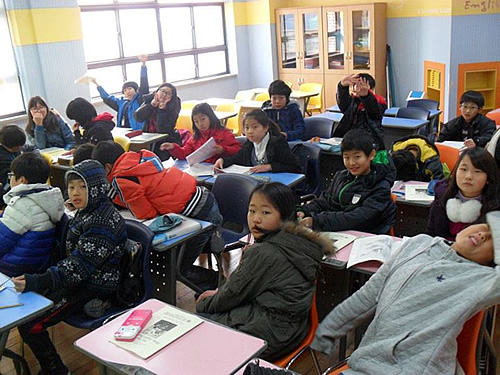 |
| Not my students, but equally uninterested. |
I also feel like there's something missing in that, though. Perhaps I'm just imagining worst-case-scenarios rather than really giving it a try. There must be a way to get students involved and motivated to speak English in more student-orientated ways without losing control of the class. A good place to start may be my sixth grade role-play lesson tomorrow morning. Then again, the co-teacher who taught them alone last lesson tells me to expect it to be... messy.
Rather than doing sixth grade role-plays, which are about as linguistically challenging as my classes get (they're actually writing the scripts themselves in teams), what about if I were to take a simple third grade lesson like "I like apples". If I took phrases such as "What do you like?" and "Do you like apples" as the target language, could I get them to have active conversations about their likes and dislikes either in groups or as a whole class?
I really don't feel as though this would work, but there must be a way. If you've gotten to the end of this post I would really appreciate your thoughts!
